Shopify or Webflow: Which CMS to Choose for Your Website or E-commerce Store in 2026?

.avif)
.avif)
.avif)
.avif)
Today, there are dozens of tools to create a website or an online store : traditional CMS, e-commerce platforms, no-code solutions, or next-generation builders.
However, when it comes to choosing a high-performing solution and one that is adapted to the current challenges of the web, most projects still face the same dilemma: Webflow or Shopify.
These two platforms dominate the market, but they operate on very distinct principles. One is designed for selling, the other for structuring, designing, and optimizing acquisition. So, which CMS should you choose in 2026 based on your project, your goals, and your digital strategy?
Understanding the fundamental differences between Shopify and Webflow
Shopify, a platform designed for online sales
Shopify has established itself in recent years as one of the most widely used e-commerce platforms in the world. It is particularly well-suited when online sales are at the core of the business model and the goal is to quickly launch a high-performing store.
Its strength lies in its “turnkey” approach : optimized purchase funnel, secure payments, and order management are natively integrated. The infrastructure is robust and designed to absorb growth without technical complexity.
Shopify becomes particularly relevant when:
- You are planning regular marketing campaigns (promotions, discount codes, flash sales),
- Your business involves multi-channel management (Instagram, marketplaces, physical stores),
- You need a optimized and proven checkout,
- Your strategy includes international expansion with multiple currencies and languages.
However, this simplicity implies a more structured framework. Design customization remains tied to themes, and some advanced features require the addition of third-party applications.

When is Shopify the right choice?
Shopify is particularly relevant when online sales are central to the business model.
It's a suitable solution if:
- Your business relies on a structured product catalog,
- Managing payments, deliveries, and inventory is strategic,
- You want a quick launch,
- Reliability and scalability are major concerns.
For e-commerce brands, DNVBs, or companies looking to streamline their sales funnel, Shopify offers a solid and secure technical foundation.
Webflow: the creative solution?
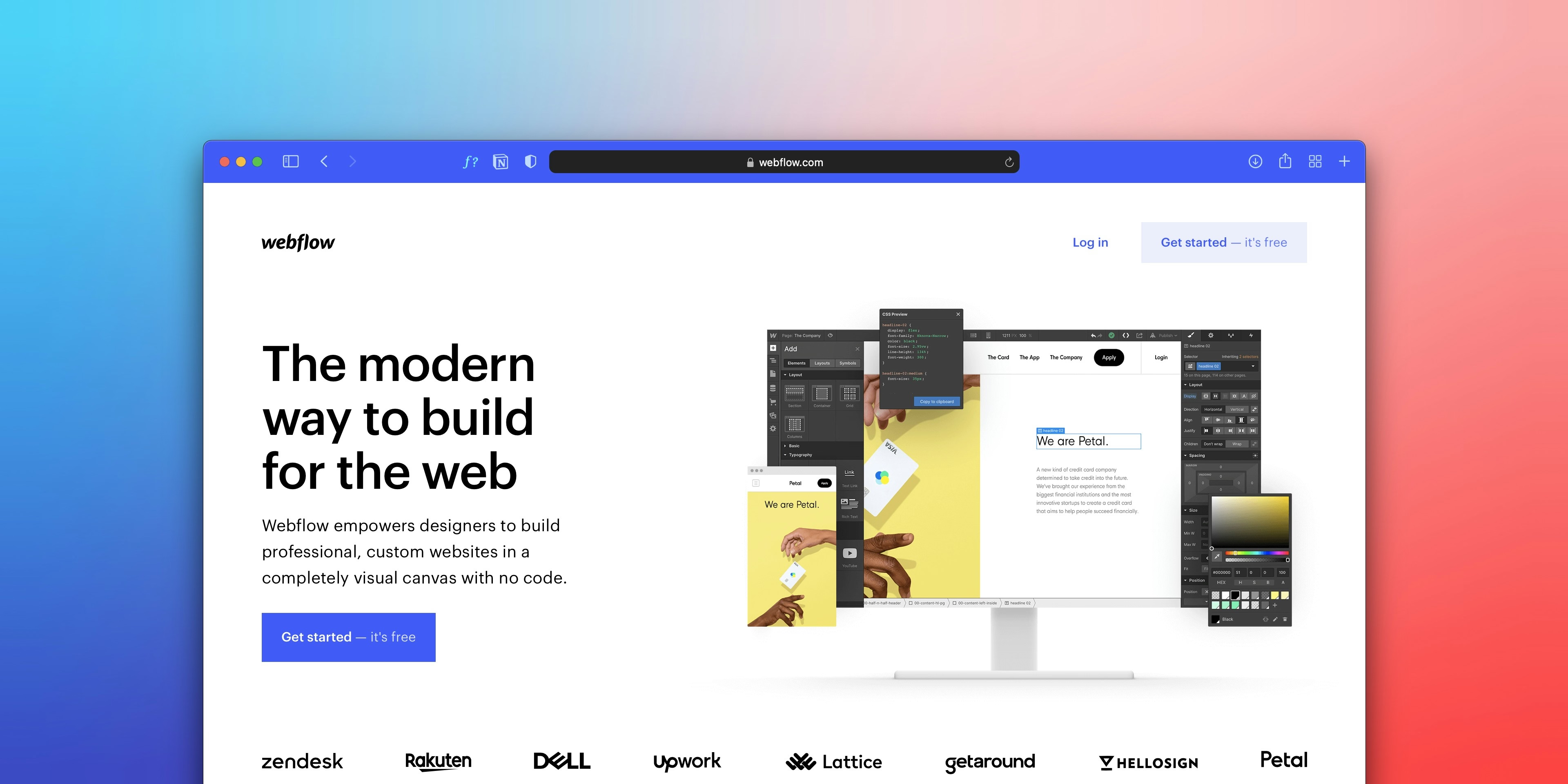
Webflow is a modern no-code CMS that allows for the creation of dynamic websites without complex development. It is primarily aimed at projects where the website plays a strategic role in branding and acquisition.
Unlike traditional theme-based CMS platforms, Webflow offers precise control over:
- Site structure,
- Design,
- User experience,
- Technical performance
Webflow enables the creation of truly distinctive websites, perfectly aligned with brand identity. From an SEO perspective, the platform generates clean and optimized code, simplifies tag management, and offers a flexible CMS for deploying a high-performing content strategy.
Webflow and e-commerce: when is it relevant?
Webflow certainly allows for the integration of e-commerce functionality. However, it is less suited for complex or highly logistics-intensive sales projects.
Unlike Shopify, Webflow does not natively manage the entire operational chain (advanced inventory management, multi-warehouse logistics, sophisticated e-commerce automations).
For ambitious e-commerce projects, this may require external integrations or custom development.
However, Webflow is particularly well-suited for:
- Selling online courses,
- Marketing digital services,
- Simple click and collect,
- Selling products with a limited catalog.
In these cases, the goal is not to manage a complex e-commerce infrastructure, but to offer a premium experience, controlled and aligned with the brand image.
A hybrid solution, the “Shopiflow” model
Why marry Shopify and Webflow?
Rather than opposing Shopify and Webflow, Some companies opt for a hybrid architecture, combining the strengths of both platforms.
The principle relies on a clear separation of roles:
- Shopify drives the e-commerce infrastructure : product management, secure payments, orders, inventory, and logistics.
- Webflow manages the interface and acquisition strategy: custom design, user experience, technical performance, and SEO optimization.
This architecture allows for the separation of the transactional layer from the experiential layer.

When to switch to a hybrid architecture?
The hybrid approach becomes relevant when:
- Brand image influences directly drives conversion,
- SEO and content are major acquisition levers,
- User experience needs to be premium (animations, transitions, smooth user journeys),
- The product catalog requires advanced logistical management, but a distinctive showcase.
This solution typically involves a higher initial investment. However, it allows for building a coherent, scalable, and capable of scaling without multiplying tools or sacrificing brand positioning.
Why work with an agency proficient in both platforms
The importance of strategic choice over the tool
Choosing between Webflow and Shopify should never be a purely technical decision. A CMS is a tool that serves a digital strategy, never the other way around. Even before discussing the tool, it is essential to clarify the project's objectives: lead generation, online sales, brand image, SEO visibility, scalability, or team autonomy.
A poor choice can hinder growth. A strategic choice, on the other hand, allows for building a sustainable and high-performing website.
Afalence's Support for Webflow and Shopify
At Afalence, we approach every project by strategy before technology. Our expertise in Webflow and Shopify allows us to guide our clients towards the solution most aligned with their ambitions.
We design high-performing websites, designed for user experience, SEO, and conversion. This support will enable your business to avoid common pitfalls and rely on a website truly aligned with your growth ambitions.
Still undecided between Webflow and Shopify?
Contact us now to determine the most suitable solution for your project and build a truly high-performing website.

See also our other articles
Discutons de vos besoins
Vous cherchez une agence de confiance pour votre projet ? Contactez-nous et découvrez comment nous pouvons vous aider