SEO KPIs in 2026 | Complete Guide to the Most Important Metrics

.avif)
.avif)
.avif)
.avif)
Tracking average position or organic traffic volume is no longer enough for an effective SEO strategy. These metrics are useful, but they don't allow for proper prioritization or proof of SEO's contribution to the business.
By 2026, the landscape has evolved. AI Overviews and new AI-powered search experiences are changing visibility in the SERPs.
User journeys are fragmenting, CTR is becoming unstable for certain queries, and SEO teams must align their reporting with concrete objectives: qualified traffic, conversions, and revenue.
This article presents the essential SEO KPIs for 2026: those to keep, those to re-evaluate, and the new metrics to adopt.
What are the most important SEO KPIs in 2026?
The SEO KPIs most important in 2026 are generally:
- Organic clicks.
- Organic impressions, especially non-brand.
- CTR on strategic pages.
- SEO-generated conversions.
- Leads or revenue attributed to organic search.
- Non-brand traffic.
- Core Web Vitals.
- Strategic page performance.
- Visibility for conversational queries.
Not all of them need to be tracked with the same level of priority. Their relevance depends on the business model, website type, and the maturity of your measurement system.

Why SEO KPIs must be re-evaluated in 2026
SEO is no longer evaluated as an isolated channel. It is compared to other acquisition channels based on its ability to generate valuable visibility, conversions, and, in many cases, actionable revenue or leads.
The end of vanity KPIs
Some SEO indicators are reassuring, but not always decisive. An increase in organic traffic or the number of ranked keywords doesn't necessarily mean that SEO is contributing more to the business. Without analyzing traffic quality, intent, and conversions, these metrics can even be misleading.
The impact of AI on organic visibility
The AI Overviews, AI-generated answers are sometimes displayed directly in Google's search results pages, thus redistributing attention within the SERPs.
For certain queries, a page can remain well-ranked while seeing its CTR decrease, because a synthetic answer already addresses part of the need before the click.
Consequently, traffic sometimes reflects a site's actual visibility less accurately than before. It therefore becomes essential to cross-reference visibility, engagement, and conversion data, and to add some indicators better suited to the new SERPs.
.avif)
The SEO KPIs that still truly matter
These KPIs remain the bedrock of reliable reporting. However, they must be segmented and interpreted within their context.
1. Organic Clicks and Impressions
Organic clicks measure the actual traffic generated from Google. Impressions indicate how often your pages appear in the results. Together, they provide an insight into your exposure and your ability to capture demand.
The most important thing is not the raw data, but the segmentation:
- Brand vs. non-brand.
- Mobile vs. desktop.
- Strategic pages vs. secondary pages.
- Informational vs. commercial queries.
A global view often masks the true performance signals.
2. Organic CTR
CTR remains a key KPI, but it needs to be analyzed with nuance. In 2026, it depends more on the type of query, SERP competition, and the presence of rich formats or AI responses.
A low CTR on a well-exposed page can indicate:
- An unconvincing title tag.
- An undifferentiated meta description.
- A mismatch between intent and the displayed promise.
- A SERP that diverts some clicks.
CTR becomes particularly useful when monitored page by page, within a restricted and priority scope.
3. Conversions and revenue from SEO
This is often the most decisive KPI for legitimizing SEO with decision-makers.
On a B2B website, it will more likely involve qualified leads, contact requests, or demo requests.
For an e-commerce site, we would more directly track revenue attributed to organic traffic, conversion rate, and sometimes average order value.
The goal is simple: move from visibility reporting to business contribution reporting. To go further in structuring truly actionable tracking, also discover our guide on Looker Studio reporting.
4. Non-brand traffic
From an acquisition perspective, non-brand traffic is one of the most useful indicators. It measures the site's ability to capture audiences who are not already searching for your brand.
This KPI often helps distinguish genuine SEO progress from growth primarily driven by existing brand awareness. To make it actionable, it must be tracked with the same diligence in Search Console and your analytics tool.

SEO KPIs to View with Caution
These indicators are not useless. They become problematic when interpreted in isolation or presented as evidence of overall performance.
1. Average Position
Search Console's average position aggregates very different situations. It can be negatively impacted by a non-strategic long tail, even as your key pages are progressing on the queries that matter.
It remains useful for detecting general trends, but it should never replace a strategic page-by-page analysis or a thematic cluster analysis.
2. Total Number of Keywords Ranked
Gaining thousands of additional keywords is of little value if these queries generate few impressions, no conversions, or an intent too far removed from your offering.
This KPI can be useful for measuring semantic expansion. It is much less relevant as a primary performance indicator.
3. Overall organic traffic without segmentation
This is one of the most common biases in reporting. Total organic traffic often mixes:
- Branded and non-branded.
- Seasonal peaks.
- Informational and transactional content.
- High-value and low-value visits.
Presented alone, it provides a simple figure to read but often lacks insights.
4. SEO sessions without intent analysis
Not all organic sessions are equal. A visit to an introductory guide and a visit to a service page do not reflect the same level of maturity.
Without intent analysis, there's a risk of overvaluing less useful traffic volumes and undervaluing pages with high commercial potential.

New SEO KPIs to integrate in the AI era
These indicators don't replace the fundamentals. They complement traditional dashboards on topics that older reports poorly covered.
Visibility on conversational queries
Long-tail queries formulated in natural language are becoming more prominent in search journeys. Their individual volume is often low, but their strategic importance can be high.
A good starting point is to isolate, in Search Console, queries of five words or more that generate impressions or clicks on your priority pages.
The performance of structured content for generative answers
Clear, well-structured, factual, and easily synthesizable content is more likely to be adopted or used in rich answer environments.
Since there isn't always a perfect native measurement, we need to reason by proxies:
- Visibility on important informational queries.
- Improved CTR on certain expert content.
- Increased presence on rich snippets or answer formats.
The conversion rate by intent type
A page designed to meet a specific intent should be judged on its ability to move the user forward in their journey.
Comparing conversion rates by content type or by intent level helps identify truly effective formats, instead of relying on an overall site average.
Assisted SEO contribution to the conversion journey
For long purchase cycles, especially in B2B, some SEO content does not convert directly but contributes to the decision.
It is therefore useful to track content involved in multi-touch journeys, even when they are not the last touchpoint before conversion.
Brand mentions in AI environments
This indicator is still emerging, but it can become relevant for brands that invest heavily in their editorial authority. The idea is not to make it a primary KPI today, but to test it as a signal complementary for presence and credibility.
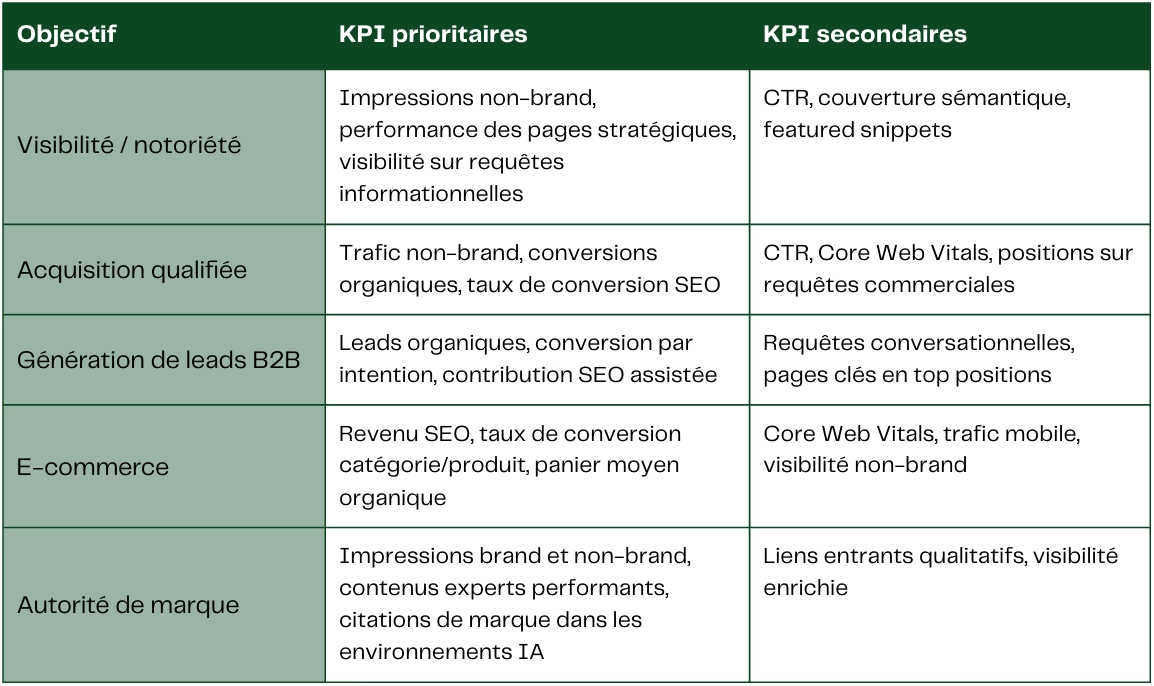
Which KPIs should you track based on your objective?
The optimal dashboard is not universal. It depends on your priority.
FAQ — SEO KPIs
How many SEO KPIs should you track?
In general, 5 to 10 well-chosen KPIs are enough. Beyond that, reporting becomes harder to read and less useful for decision-making.
Can SEO be effectively tracked without GA4?
Yes. Search Console already tracks clicks, impressions, CTR, and positions. For conversion, other Analytics tools can be suitable if tracking is properly configured.
Are Core Web Vitals still important in 2026?
Yes. They remain a key indicator of user experience quality and an expected standard for strategic pages.
The easiest way is to observe the variations in CTR and clicks for your strategic informational queries, then compare them to the evolution of impressions.
Why partner with an SEO agency like Afalence?
In 2026, tracking the right SEO KPIs is no longer about stacking metrics in a dashboard. It's essential to distinguish the truly useful indicators, segment them correctly, link them to your business objectives, and interpret them in light of the new realities of search.
Partnering with an agency like Afalence, means benefiting from comprehensive SEO support with optimized content creation at a competitive rate.
We offer a free initial audit of your site, which you can book via our contact form.

See also our other articles
Discutons de vos besoins
Vous cherchez une agence de confiance pour votre projet ? Contactez-nous et découvrez comment nous pouvons vous aider