How to Optimize Your Google Ads Campaign in 2026?

.avif)
.avif)
.avif)
.avif)
Launching a Google Ads campaign is simple.
Making it truly effective is more complex.
Many advertisers launch their campaigns, generate clicks, but struggle to turn these investments into measurable results. Poor budget allocation, unclear structure, overly broad targeting, unoptimized landing pages: the causes are numerous.
Optimizing a Google Ads campaign isn't about “making a few adjustments”. It's a comprehensive strategic effort.
To improve profitability, you need to act on the structure, keywords, ads, targeting, and post-click experience.
I. Define a clear strategy before any optimization
Identify the right performance metrics
Before modifying bids or adding keywords, it's essential to clarify your objectives.
Are you looking to generate qualified leads? To sell online? To build brand awareness? To capture a local audience?
Each objective requires different metrics: cost per acquisition (CPA), return on investment (ROI), ROAS, conversion rate. An optimized campaign is first and foremost a campaign aligned with specific KPIs.
Without clear objectives, optimization becomes imprecise.
Tailor the bidding strategy to the intent
This step also allows us to determine the target intent level and adapt the bidding strategy accordingly. A lead generation-focused campaign does not use the same parameters as an e-commerce campaign driven by ROAS.
II. Intelligently Structure Your Campaigns and Ad Groups
Segment by Search Intent
The internal structure of the account directly influences performance.
Grouping heterogeneous keywords within the same campaign dilutes ad relevance.
Segmenting by intent (informational, commercial, transactional) helps improve the consistency and readability of results.
Each ad group should contain semantically similar keywords in order to produce perfectly aligned ads.
Cleaning up traffic with negative keywords
Analyzing search terms and mastering keyword match types allows to exclude irrelevant queries and improve traffic quality. A clear structure is the foundation of a profitable campaign.
III. Improve Click-Through Rate (CTR) without sacrificing quality
Write intention-driven ads
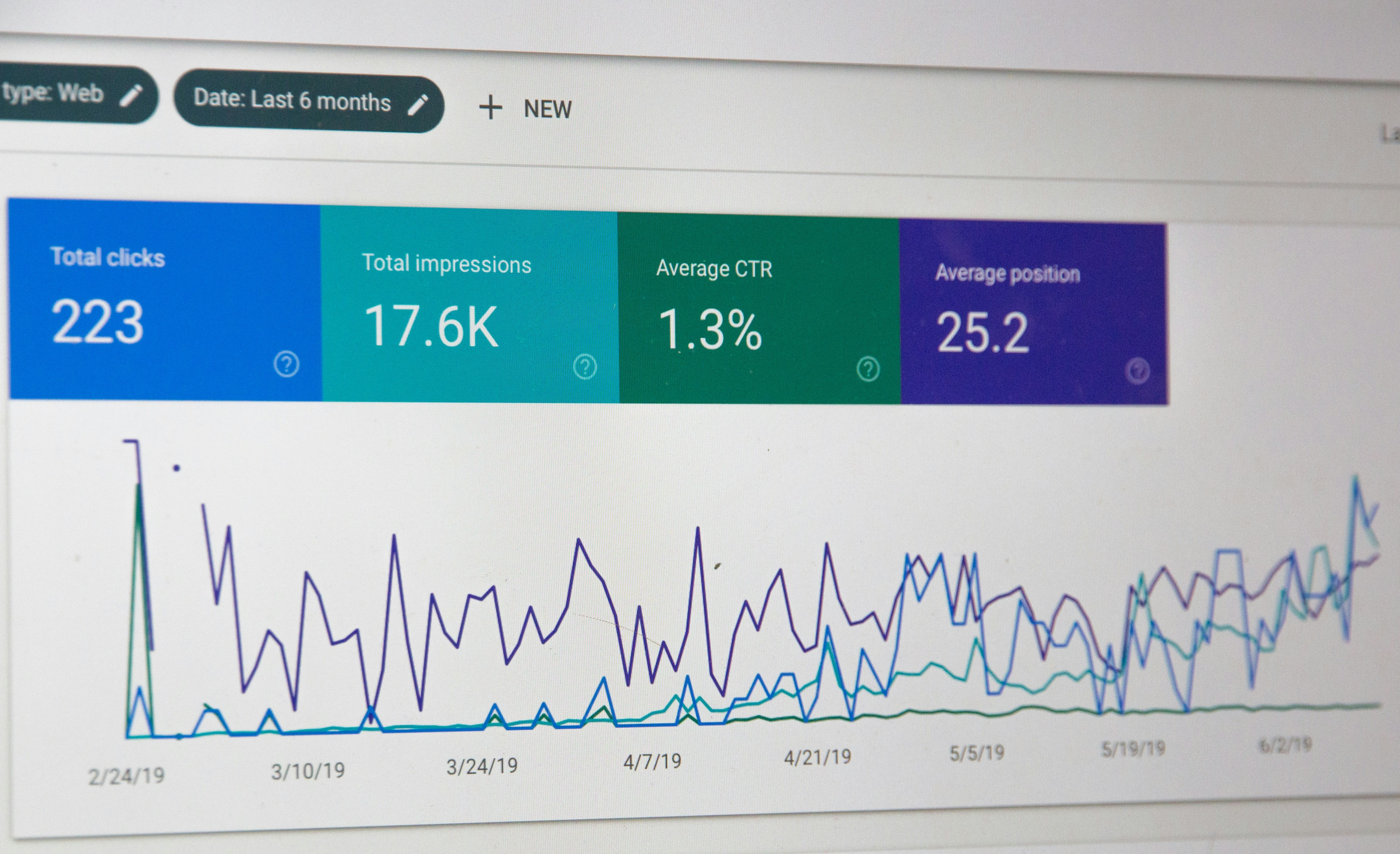
Click-through rate measures an ad's ability to capture attention in search results. A high-performing ad incorporates the terms searched by the user and highlights a clear benefit. A message that is too generic reduces engagement. A precise promise will increase the likelihood of a click.
Leverage ad extensions
Extensions enhance visibility and credibility. They enable totake up more space in the SERP and improve overall performance.
The goal is not to attract more clicks, but to attract the right clicks.
IV. Optimize Quality Score to Reduce Cost Per Click
The Quality Score acts directly on the cost per click and ad position. It is based on three pillars:
· Expected click-through rate,
· Ad relevance
· Page experience.
Aligning keywords and ad copy
The stronger the match between the query and the ad, the more Google considers the ad relevant. This consistency improves the score and automatically reduces the cost per click.
Precisely addressing the on-page intent
Google evaluates whether the page truly matches the initial query.
This is about semantic consistency, not yet advanced UX optimization.
Quality Score is primarily a financial lever, rather than a marketing one.
V. Optimize the landing page to increase conversion rate
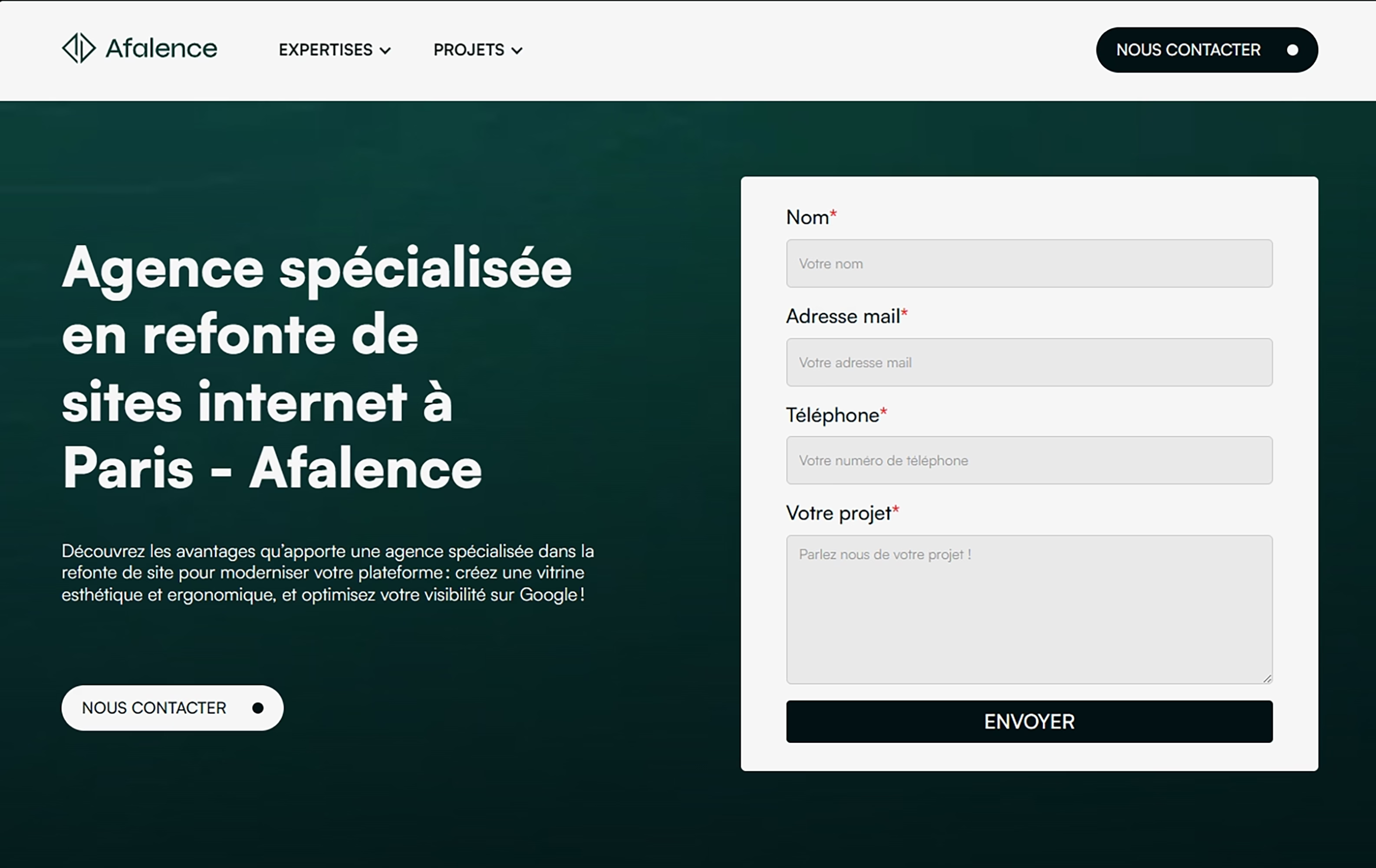
Once the click is achieved, the logic changes: it's no longer about optimizing an advertising metric, but about converting an intention into action. The landing page must reassure within seconds. The user must understand they are in the right place.
A mismatch between the ad and the page increases the bounce rate and reduces overall performance.
Clear visual hierarchy, benefit-oriented messaging, form simplification and reassurance elements influence directly the conversion rate.
Conversion happens after the click.
VI. Leverage advanced targeting to focus the budget
A well-structured campaign can remain ineffective if the distribution is poorly configured.
Google Ads allows you to refine ad reach based on:
· Intent audiences,
· Demographics,
· Geolocation,
· Devices,
· Remarketing.
The goal is to limit unnecessary impressions and focus the budget on profiles with a high probability of conversion.
Optimizing targeting improves profitability without increasing spend.
VII. Analyze Data and Optimize Continuously
A Google Ads campaign is never static.
Optimization is based on:
· Analyzing performance by segment,
· Adjusting bids,
· Refining targeting,
· Leveraging automated strategies.
Sustainable performance comes from a constant iterative approach.

Common errors that limit performance
Certain errors hinder profitability:
· Lack of a clear strategy,
· Focusing on clicks rather than ROI,
· Underutilization of data,
· Lack of testing,
· Misalignment between acquisition and business objectives.
Identifying these weaknesses allows for rapid gains without necessarily increasing the budget.
FAQ: Optimizing Your Google Ads Campaign
What is a good Google Ads CTR?
A CTR between 3% and 7% is generally considered strong on the Search Network. However, it must be analyzed in conjunction with the conversion rate and the cost per acquisition.
How to reduce cost per click?
Improving your Quality Score remains the primary driver. Better keyword relevance, ads and page allows to lower the CPC.
Why isn't my campaign converting?
A mismatch between search intent, the ad message [SEGEMENT 11] and the landing page is often the cause. Analyzing the user journey helps to identify friction points.
Are automatic bids effective?
Yes, if the v
olume of data is sufficientand that theconversion tracking is correctly configured.
Why work with a Google Ads expert agency
Optimizing a Google Ads campaign requires time, analysis, and technical expertise.
At Afalence, our Google Ads management expertise aims to structure campaigns around measurable objectives and to sustainably improve profitability. Every lever – structure, ad, targeting, and conversion – is aligned to deliver tangible results.
Are you looking to optimize your Google Ads campaigns and improve your return on investment?
Contact us to analyze your strategy and identify areas for improvement.

See also our other articles
Discutons de vos besoins
Vous cherchez une agence de confiance pour votre projet ? Contactez-nous et découvrez comment nous pouvons vous aider